

Thuringia Marble Pendant
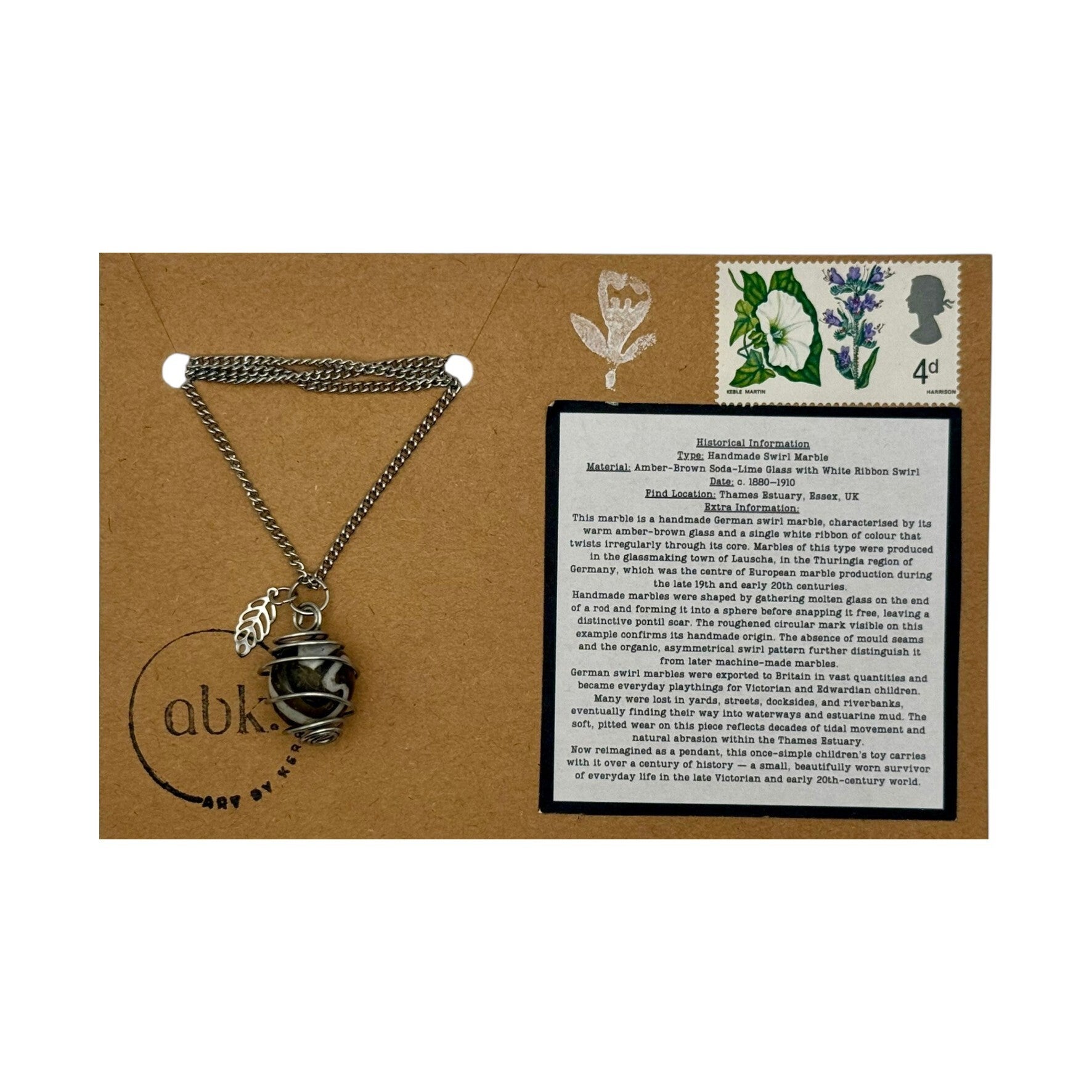
Historical Information
Type: Handmade Swirl Marble
Material: Amber-Brown Soda-Lime Glass with White Ribbon Swirl
Date: c. 1880-1910
Find Location: Thames Estuary, Essex, UK
Extra Information:
This marble is a handmade German swirl marble, characterised by its warm amber-brown glass and a single white ribbon of colour that twists irregularly through its core. Marbles of this type were produced in the glassmaking town of Lauscha, in the Thuringia region of Germany, which was the centre of European marble production during the late 19th and early 20th centuries. Handmade marbles were shaped by gathering molten glass on the end of a rod and forming it into a sphere before snapping it free, leaving a distinctive pontil scar. The roughened circular mark visible on this example confirms its handmade origin. The absence of mould seams and the organic, asymmetrical swirl pattern further distinguish it from later machine-made marbles. German swirl marbles were exported to Britain in vast quantities and
became everyday playthings for Victorian and Edwardian children. Many were lost in yards, streets, docksides, and riverbanks , eventually finding their way into waterways and estuarine mud. The soft, pitted wear on this piece reflects decades of tidal movement and natural abrasion within the Thames Estuary. Now reimagined as a pendant, this once-simple children's toy carries with it over a century of history - a small, beautifully worn survivor of everyday life in the late Victorian and early 20th-century world.